Compare forced aeration and mechanical turning for organic waste processing. See how Enzymefield supports heat consistency, odor control, throughput, and finished compost quality.
Request pricingHigh-volume composting is not won by one control lever. It is won by keeping oxygen, moisture, structure, temperature, and biology moving in the same direction while feedstock keeps changing.
For a composting facility handling food waste, green waste, biosolids, manure, paper residuals, or mixed organics, the choice between forced aeration and mechanical turning affects labor, odor pressure, pad space, heat profile, throughput, and product consistency.
Enzymefield works as a compost enzyme supplier for organic waste processing where facilities need more predictable breakdown under real operating conditions. Enzyme support does not replace aeration or turning. It helps the biological side of the process respond faster and more evenly when process controls are under pressure.
Forced aeration and turning both aim to prevent oxygen-limited zones. They do it differently.
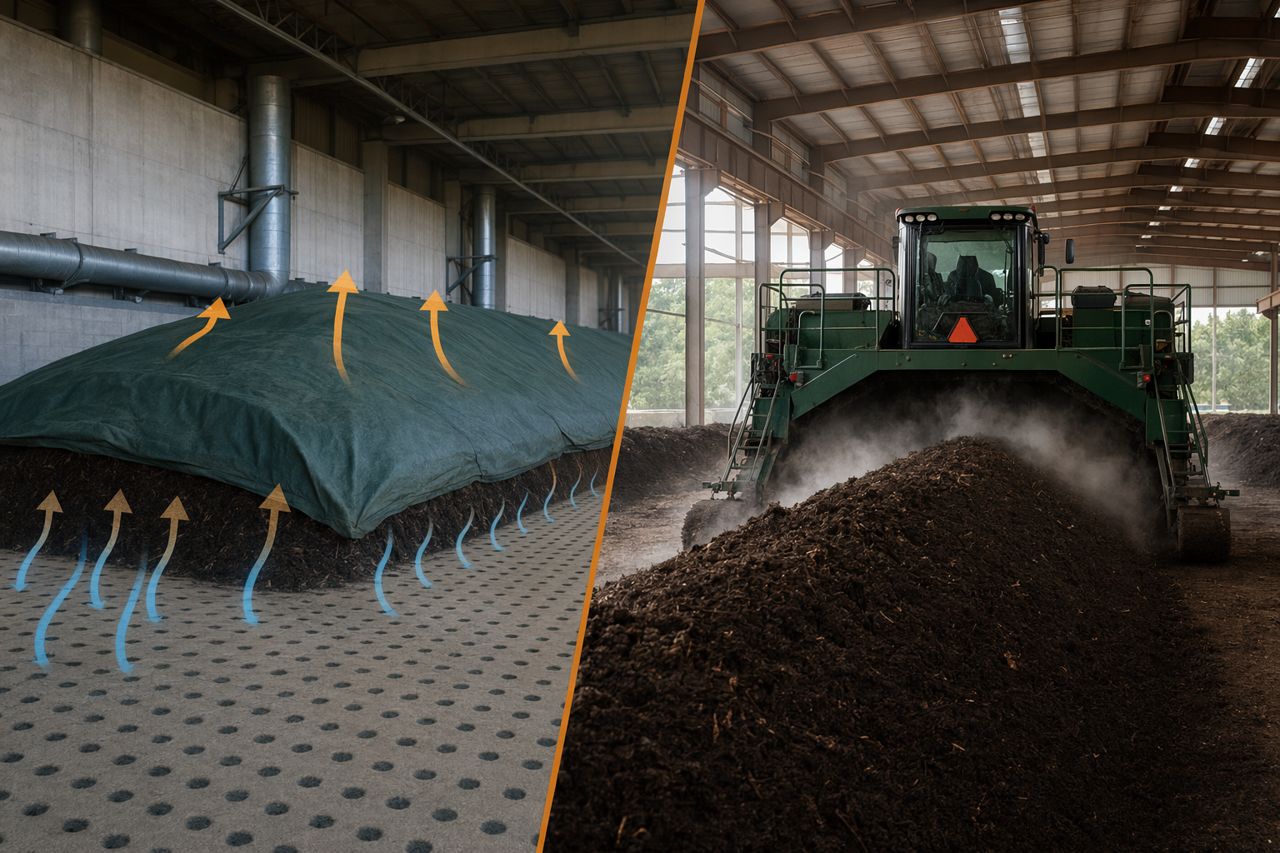
Forced aeration uses blowers, piping, floors, or covered systems to move air through static piles, bays, or vessels. The pile may stay largely in place while airflow is controlled by timers, sensors, or operator settings.
Best suited for facilities that want:
Forced aeration is strongest when the pile has the right porosity. If the feedstock mats, compacts, or carries excess moisture, airflow can channel through easy pathways while dense sections remain slow, wet, or anaerobic.
Turning uses a windrow turner, loader, excavator, or mixer to physically open the pile, redistribute material, release trapped gases, blend moisture, and expose new surfaces.
Best suited for facilities that need:
Turning is powerful because it resets structure. But every pass costs labor, fuel, equipment wear, scheduling bandwidth, and potential odor release if the material is not ready to be opened.
A practical way to decide is this:
Most commercial composting facilities use a balance of both. The question is not which one is universally better. The better question is which control strategy protects your bottleneck.
Odor risk rises when wet, compacted, high-nitrogen material loses oxygen or is opened at the wrong time.
Forced aeration can reduce odor pressure by keeping piles oxygenated without frequent disturbance. Covered aerated systems can also help contain and treat process air.
Turning can reduce odor when it prevents anaerobic pockets from staying buried too long. But turning can also release odor spikes if done during unstable stages, after rain loading, or when incoming feedstock is overloaded with putrescibles.
For odor-sensitive sites, the operational target is not maximum airflow or maximum turning. It is stable aerobic breakdown with fewer shock events.
Enzymefield enzyme solutions support this by helping break down complex organic fractions more consistently, which can reduce the amount of partially degraded material sitting in oxygen-stressed zones.
Throughput depends on how quickly a facility can move material through active composting without sacrificing maturity, temperature performance, or screening quality.
Forced aeration can improve throughput when it keeps heat and oxygen in a controlled range with less manual intervention. This can support denser site planning and more predictable residence time.
Turning can improve throughput when the incoming stream is inconsistent and needs repeated blending to avoid cold spots, wet cores, or oversized pockets.
The throughput risk is different for each method:
Enzyme support is useful when the site needs more biological response inside the same footprint, especially when feedstock composition changes week to week.
Heat consistency matters for pathogen reduction, weed seed control, process confidence, and cycle planning.
Turning often creates a visible heat rebound by remixing active and cooler zones. It can bring outer material into the core and expose new surfaces for microbial action.
Forced aeration helps hold heat more evenly when airflow is managed correctly. Too little air creates oxygen stress. Too much air can strip heat and moisture.
Operators should watch for:
Enzymefield positions enzymes as a support layer for breakdown consistency, not a substitute for temperature monitoring or pile management.
Real facilities rarely receive perfect recipes. One week brings wet food waste. Another brings woody overs. Then comes grass, leaves, manure, packaging contamination, or industrial organics.
Turning handles variability by mixing. Aeration handles variability only after the pile is structurally prepared to breathe.
When the feedstock mix is unpredictable, facilities often need:
This is where a compost enzyme supplier can add operational value. The goal is not to make bad pile construction disappear. The goal is to help the process stay more responsive when the incoming material is not ideal.
| Facility priority | Forced aeration advantage | Turning advantage | Watch-out |
|---|---|---|---|
| Odor pressure | Less disturbance and better compatibility with covers | Breaks up anaerobic pockets | Turning unstable material can create odor spikes |
| Labor control | Lower daily machine movement | Flexible with existing mobile equipment | Turning requires scheduling and operator time |
| Heat consistency | Can maintain stable thermal zones | Redistributes hot and cool material | Excess airflow can cool piles; poor turning can expose wet cores |
| Feedstock variability | Works well after good pile construction | Strong correction and blending tool | Aeration cannot fix collapsed structure alone |
| Throughput | Supports controlled static processing | Speeds correction in windrow systems | Both fail if moisture and structure are unmanaged |
| Finished compost quality | Can deliver even processing in controlled zones | Improves homogenization before curing | Incomplete breakdown shows up at screening and curing |
Choose forced aeration as the lead control when your facility needs high control, reduced disturbance, and more predictable airflow management.
It is usually a strong fit when:
Forced aeration performs best when the pile is engineered before air is applied. If incoming material is too wet, too fine, or too compacted, blowers may move air around the problem rather than through it.
Choose turning as the lead control when your facility needs flexibility, active blending, and fast physical correction.
It is usually a strong fit when:
Turning performs best when operators follow a plan instead of reacting only after odor, heat loss, or wet zones appear.
Many facilities get the best result from a hybrid method:
This approach reduces unnecessary disturbance while keeping operators ready to intervene when the pile tells them to.
Enzymefield supplies enzyme solutions for composting operations that want more predictable organic breakdown without adding another layer of lab complexity to daily operations.
We focus on buyer outcomes that matter on the pad:
Enzymes are not a magic fix for poor aeration, weak pile structure, or unmanaged moisture. They are a process support tool for facilities that already care about control and want the biology to keep pace with the operation.
Use this checklist before changing your aeration or turning plan:
The right answer may be more aeration, better turning discipline, improved pile construction, enzyme support, or a tighter combination of all four.
Forced aeration gives composting facilities more controlled oxygen delivery. Turning gives facilities physical correction and blending power. High-volume organic waste processing usually needs both, matched to the site’s real constraint.
Enzymefield helps facilities add biological consistency to that control plan, especially when variable feedstocks, odor pressure, and throughput targets are competing on the same pad.
Planning a process adjustment or evaluating enzyme support for your composting operation? Use the on-site request form to tell us about your feedstock mix, system type, and operating goals. Enzymefield will help scope a practical supply recommendation for your facility.

Tell us your application and volume — we reply with pricing and lead time.
We have received your message. We will reply by email.